
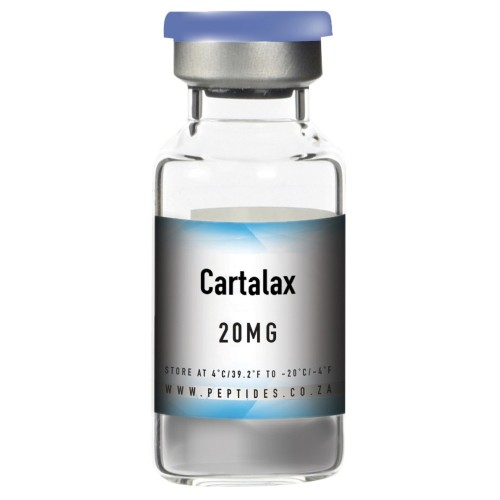
Description
Clinical Test Expectation – Cartalax – 20mg – Human Subjects : Maintaining the health of connective tissues and cartilage by enhancing fibroblast activity and facilitating tissue regeneration. Aids Osteochondrosis, Arthrosis, and Osteoporosis. Kidney support and cellular anti-aging.
Strength – 20mg per vial
Detailed Product Information
Cartalax is a bioregulator composed of short peptides that aids in maintaining the health of connective tissues and cartilage by enhancing fibroblast activity and facilitating tissue regeneration. It is utilized to restore the normal functioning of the musculoskeletal system and is advised for ailments impacting the joints and spine, including osteochondrosis, arthrosis, and osteoporosis. Additionally, it may assist in preserving the extracellular matrix, which provides strength to tissues, and supports the resilience of cells in aging tissues.
Cartalax, or AED or T-31 peptide, is a synthetic peptide designed to target specific biological pathways that may have implications in cellular aging. The peptide is based on the sequence of amino acids derived from the alpha-1 chain of type XI collagen (hence AED, standing for the amino acid sequence Alanine-Glutamate-Aspartate). It has also been isolated from kidney extracts containing polypeptides. Peptides like Cartalax are often investigated for their potential to modulate biological processes, including inflammation and cartilage repair, which are significant factors in osteoarthritis. More specifically, it is classified among the Khavinson peptides and has been suggested by researchers to act as a bioregulator.
Cartalax and Fibroblasts
The peptide Cartalax, when investigated for its effects on skin fibroblasts, seems to possess characteristics that could potentially affect the aging process of these cells in culture.(1) It has been proposed that Cartalax may play a significant role in various essential cellular processes that are crucial for the function and longevity of fibroblasts. To begin with, Cartalax may aid in the proliferation of fibroblasts, as indicated by its possible enhancement of Ki-67 expression. Ki-67 is a widely recognized marker linked to cell proliferation. Typically, the expression of Ki-67 diminishes as fibroblasts age in culture. The observation that Cartalax appears to elevate Ki-67 levels suggests that this peptide may stimulate fibroblast growth or extend their replicative lifespan, potentially counteracting the natural reduction in cell division that occurs over time.
Cartalax and Kidney Cells
The peptide known as Cartalax may possess the ability to positively affect the regeneration of kidney cells. This potential effect is based on findings from organotypic kidney tissue cultures derived from both young and aged murine models, where the presence of Cartalax was linked to enhanced cellular proliferation. This proliferative effect was seemingly indicated by an elevated expression of the marker Ki-67, which is widely utilized to assess cell proliferation. Additionally, Cartalax may play a role in reducing apoptotic processes within kidney cells. The peptide appears to potentially counteract this by lowering the expression of the pro-apoptotic peptide p53. High levels of this protein are believed to promote apoptosis, and its down-regulation by Cartalax implies that the peptide could assist in preserving cellular integrity and extending cell survival. Therefore, the findings presented in this study also highlight Cartalax as a molecule of interest regarding its potential impact on the aging process of kidney cells.
Cartalax and Cellular Aging
In addition to its potential effects on fibroblasts and kidney cell cultures, Cartalax has also been investigated for its possible influence on bone marrow mesenchymal stem cells. Specifically, the peptide Cartalax may have a significant impact on the cellular mechanisms associated with aging in bone marrow mesenchymal stem cells, as indicated by findings from a study that analyzed gene expression levels in cells undergoing the aging process in two different contexts: “passages,” which refers to their proliferation phase, and “stationary,” which pertains to non-proliferating conditions. As cells age, they progress through various stages, often referred to as “passages” in cell culture, indicating the number of times the cells have divided and been subcultured. Ultimately, cells reach a “stationary” growth phase, typically linked to cellular senescence, during which they cease to divide but remain metabolically active. This phase may serve as a reflection of the aging process in cells.
Dosing Details – Cartlax – 20MG
You inject 2ml water into the vial of Cartalax from the water vial. 1 full syringe is 1ml. You then wait for the vial powder content to dissolve ON ITS OWN. DO NOT SHAKE THE VIAL TO MIX POWDER. Once dissolved and clear in colour you draw out 20 (2 units) on the syringe each night before bed and inject it into the tummy under the skin into the fatty skin layer.
How long will a vial last ?
A vial should last 10 days.
Reviews
There are no reviews yet.