
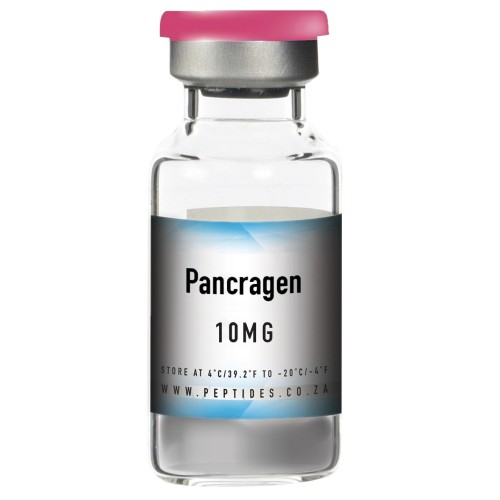
Description
Clinical Test Expectation – Pancragen – 10mg – Human Subjects : Stimulates the expression of differentiation factors within pancreatic cells, promoting their maturation and healthy function. Improve glucose metabolism, blood sugar control, and insulin production. Regulate melatonin expression, reducing metabolic syndrome, and has been shown to support tissue repair within the pancreas.
Strength – 10mg per vial
Detailed Product Information
Pancragen is a tetrapeptide characterized by the sequence Lys-Glu-Asp-Trp (KEDW). It serves as a synthetic structural analog of a peptide derived from cattle pancreatic cells, which is believed to be a potential peptide bioregulator for pancreatic function and metabolic issues related to aging. Researchers have proposed that Pancragen operates by penetrating cellular membranes and engaging with the nucleus and nucleolus. This interaction suggests it may affect gene transcription related to cell differentiation in pancreatic cells. Key differentiation factors such as Ptf1a, Pdx1, Pax6, Foxa2, Nkx2.2, and Pax4 are considered crucial for the proper differentiation of pancreatic cells. It is hypothesized that Pancragen could enhance the expression of these factors, indicating a beneficial effect on the maturation of pancreatic cells. Additionally, Pancragen may impact the expression of molecules including MMP2, MMP9, serotonin, CD79alpha, Mcl1, PCNA, and Ki67, implying it could enhance the functional activity of pancreatic cells. Another potential mechanism involves a reduction in the proapoptotic protein p53 and an increase in the antiapoptotic protein Mcl1, suggesting an antiapoptotic capability. Furthermore, Pancragen may affect aging biomarkers by decreasing the activities of caspase-3 and cathepsin B, as well as modulating the levels of TNF-α and IGF-I. The research on IGF-I, known for its antiapoptotic properties, indicates that the actions of Pancragen may be associated with metabolic correction and antiapoptotic mechanisms. Lastly, Pancragen appears to influence the methylation patterns of genes such as PDX1, PAX6, and NGN3, which may mediate some of its anti-aging effects on pancreatic cells
Pancragen and the Pancreas
The tetrapeptide Pancragen has been investigated for its possible effects on pancreatic cells, especially concerning cell differentiation and the regulation of insulin and glucagon release, which are vital components of the endocrine function of pancreatic cells. (1) Research has suggested that Pancragen could penetrate cellular membranes to engage with the nucleus and nucleolus, potentially affecting the transcription of genes essential for cellular differentiation within the pancreatic gland. Important differentiation factors such as Ptf1a, Pdx1, Pax6, Foxa2, Nkx2.2, and Pax4 are critical for the proper functioning and differentiation of various pancreatic cell types. It is believed that Pancragen’s interaction may potentially enhance the expression of these factors, which could contribute to the cellular maturation process of both acinar and islet cells in the pancreatic gland. The experiments performed on embryonic cultures of pancreatic acinar cells in this study indicated that Pancragen might significantly boost the expression of Ptf1a and Pdx1 proteins, which are recognized as essential for the maturation of acinar and islet cells.The research indicated that the effects of Pancragen may be more significant in older cultures, where a noticeable reduction in the expression of these proteins is evident as part of the cellular aging process.
This possible enhancement of crucial differentiation factors by Pancragen is believed to potentially result in greater differentiation of pancreatic cells, which may subsequently assist in restoring the functional activity of pancreatic cells to a condition similar to that found in younger cell cultures.
The researchers also suggested that “transcription factors that govern the differentiation of pancreatic cells represent a pharmacological target for Pancragen, thereby positioning it as a valuable tool in the management of diabetes mellitus and pancreatitis.”
Pancragen and Metabolic Issues
Research has investigated the effects of Pancragen on metabolic issues in older test subjects. For instance, one study primarily concentrated on carbohydrate metabolism and the possible influence of Pancragen in its regulation.(4) The introduction of Pancragen was found to significantly reduce fasting glucose levels during a standard glucose tolerance test, along with a decrease in insulin levels and the insulin resistance index. This indicates a potential application of Pancragen in mitigating disturbances in carbohydrate metabolism, particularly considering the sustained glucose-lowering effect observed after exposure. It is important to highlight that the study was conducted on older test subjects, and the extent of Pancragen’s potential may depend on various other factors, including the degree of insulin resistance and additional variables. The researchers also noted that “The administration of the tetrapeptide Pancragen represents a promising strategy for correcting insulin resistance in the elderly.”
Pancragen and Aging
Pancragen has been proposed as a potential bioregulator for addressing metabolic issues linked to aging. To evaluate Pancragen’s effects on aging, a study investigated its influence on murine models of varying ages.(7) A significant reduction in specific aging biomarkers, such as caspase-3 and cathepsin B activities, was observed when Pancragen was administered to the younger murine models. Notably, in the older murine models, the application of Pancragen led to a marked decrease in TNF-α levels and an increase in IGF-I, both of which are essential indicators related to aging and metabolic functions. The research also explored a rapid experimental aging model by inducing diabetes mellitus in murine models. It was noted that Pancragen potentially normalized blood glucose levels, highlighting its previously recognized hypoglycemic effects. Additionally, the presence of Pancragen may have inhibited certain apoptotic enzymatic components in pancreatic cells, indicating that its biological effects could be linked to both metabolic regulation and antiapoptotic mechanisms. The influence of Pancragen on natural biological aging is likely manifested at the IGF-I level, known for its antiapoptotic properties as a “survival factor.” Furthermore, the tetrapeptide’s potential interaction with specific genes implies that its effects may also reach the level of proteolytic processing.
Dosing Details – Pancragen – 10MG
You inject 2ml water into the vial of Pancragen from the water vial. 1 full syringe is 1ml. You then wait for the vial powder content to dissolve ON ITS OWN. DO NOT SHAKE THE VIAL TO MIX POWDER. Once dissolved and clear in colour you draw out 20 (2 units) on the syringe each night before bed and inject it into the tummy under the skin into the fatty skin layer.
How long will a vial last ?
A vial should last 10 days.
Reviews
There are no reviews yet.