
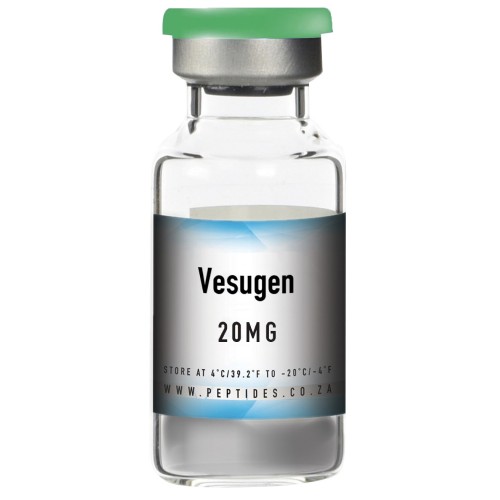
Description
Clinical Test Expectation – Vesugen – 20mg – Human Subjects : Aids neurodegenerative conditions. Promotes vascular health and regeneration. Stimulation of blood vessel cells to normalize function of, and restore protein synthesis to heart. Supports cardiovascular function. Improve microcirculation, and help prevent age-related vascular diseases. Modulate gene expression, which may influence cellular repair and the maintenance of blood vessel integrity
Strength – 20mg per vial
Detailed Product Information
Vesugen, also known as KED, is a bioregulator peptide that has been identified within the category of peptides isolated and synthesized by the Russian scientist Vladimir Khavinson. This tripeptide is derived from a sequence of amino acids associated with vascular wall proteins, specifically comprising the amino acids lysine, glutamic acid, and aspartic acid. Vesugen is primarily recognized for its potential effects on vascular endothelial cells. Moreover, its potential applications extend to a broad range of biological processes, rendering it a significant research compound in the fields of anti-aging and neuroprotection studies. Notably, Vesugen is acknowledged for its possible vasoprotective effects, particularly regarding its role in the maintenance and repair of vascular endothelial cells, which constitute the lining of blood vessels. Beyond its vascular implications, Vesugen has also been investigated for its neuroprotective and geroprotective effects. Research has focused on its impact on neuron survival and morphology, indicating its potential role in addressing neurodegenerative diseases and promoting neuroplasticity.
Vesugen and Geroprotective Potential
Vesugen has the potential to affect the behavior of prostatic fibroblasts, particularly in relation to the expression of specific differentiation factors. This potential was noted in scenarios where these cells displayed signs of aging, indicated by a decrease in the expression of differentiation markers in late-passage cultures.(5) Specifically, it is suggested that Vesugen stimulates the expression of CXCL12 and WEGC1 in these prostatic fibroblasts. CXCL12, also referred to as stromal cell-derived factor 1 (SDF-1), is a chemokine, which is a type of signaling protein. It is primarily recognized for its potential role in the immune system, where it may assist in regulating the movement of immune cells. Additionally, CXCL12 may play a part in other biological processes, such as hematopoiesis (the formation of blood cellular components) and angiogenesis (the development of new blood vessels). Its importance in cellular signaling may also extend to influencing cell migration and activation, although the complete range of its actions and interactions in various tissues remains an area of ongoing research. Conversely, WEGC1 is less thoroughly investigated, and its role is not as well-defined in the existing literature. It may be involved in cellular differentiation processes, particularly in certain cell types like fibroblasts. The precise functions of WEGC1, including its influence on cell behavior and its interactions with other cellular components, are topics that necessitate further detailed investigation. Its identification in studies related to cellular aging and differentiation, such as those involving Vesugen, implies that it could play a role in these processes, but the extent and nature of this role have yet to be fully clarified. Most importantly, the potential of Vesugen appeared to be more significant in aged cultures. This indicates, albeit with some uncertainty, that Vesugen may demonstrate geroprotective effects, potentially aiding in the preservation or rejuvenation of cellular functions that diminish with age.
Clinical research has also sought to investigate Vesugen’s potential in altering biological age markers, which are crucial to the aging process, thereby highlighting its geroprotective capabilities.(6) Vesugen has been reported to demonstrate a significant anabolic effect, which correlates with enhanced functionality in the central nervous system and other essential organs. This effect was linked to a possible deceleration of the aging process as indicated by biological age metrics. A noteworthy element of the study was the detection of prooxidant activity via chemiluminescence. This indicates that Vesugen may trigger certain oxidative processes. Furthermore, a decrease in CD34+ positive hematopoietic multipotent cells in the bloodstream was noted, implying a potential suppression of hemopoiesis. This observation suggests that these cells may not be actively participating in adaptive responses during the evaluation of Vesugen.
Vesugen and Neuroprotective Potential
The exploration of Vesugen’s neuroprotective capabilities in the realm of neurodegeneration has shed light on the significant influence of the peptide on neuroplasticity and neuronal structure in murine models that replicate specific neurodegenerative conditions.(3) A pivotal component of this study involved the assessment of long-term potentiation (LTP) within the hippocampus, an essential region for memory and learning. The neurodegenerated murine models exhibited a tendency towards diminished neuroplasticity when compared to wild-type murine models, especially following high-frequency stimulation of Schaffer’s collaterals. Nevertheless, the detected impairment in neuroplasticity was not statistically significant, indicating a merely subtle effect.
The exposure to the Vesugen peptide in these murine models indicated a potential for the restoration of long-term potentiation (LTP), implying a role in the enhancement of neuroplasticity. However, despite this encouraging indication, the effect of the Vesugen peptide on LTP restoration did not achieve statistical significance, leaving its influence as a promising yet unverified hypothesis.
Additionally, the study explored the effects of the Vesugen peptide on neuronal morphology, with a particular emphasis on dendritic spine density in the CA1 region of the hippocampus. This region is crucial for synaptic connections and is significantly impacted during neurodegeneration. The research revealed that the administration of the Vesugen peptide contributed to the preservation of postsynaptic structures in CA1 neurons within the neurodegeneration murine models. Notably, the most significant effect of Vesugen was observed in the restoration of mushroom and thin spines, which are essential for synaptic strength and memory retention. This observation is consistent with existing literature regarding spine balancing in the progression of neurodegeneration, suggesting that Vesugen may exert a modulatory effect on spine morphology.
Furthermore, the study identified sex-related differences in the neuroprotective effects of the Vesugen peptide in neurodegeneration murine models. In male subjects, the Vesugen peptide significantly enhanced dendritic spine density and restored the number of mushroom spines, indicating a gender-specific response in its neuroprotective effects. The authors noted that the neuroprotective potential of Vesugen and similar peptides is “characterized by their capacity to prevent the elimination of dendritic spines and impairments in neuroplasticity at the molecular epigenetic level.”
Another study was conducted to explore the mechanisms underlying the potential of Vesugen in treating neurodegenerative disorders.(4) The main emphasis was on its effect on gene expression and protein synthesis, which are vital in processes such as apoptosis, aging, neurogenesis, and specifically, neurodegeneration. Experimental results, along with published studies, indicate that Vesugen may influence the expression of genes related to cellular aging and apoptosis, including р16 and р21. These genes are essential in determining cell lifespan and programmed cell death, which are significant factors in neurodegenerative conditions. Additionally, Vesugen seems to impact genes and proteins involved in neuronal differentiation, such as NES (Nestin) and GAP43. Nestin is a type of intermediate filament protein that may provide structural support to cells, especially during the early developmental stages of the nervous system. Conversely, GAP43 is a protein that could be crucial for axonal growth during neural development and for the regeneration of neurons. The modulation of these genes and proteins by Vesugen could be vital in promoting neurogenesis, a process that may help mitigate neurodegenerative processes. Furthermore, the peptide appears to interact with genes associated with the pathogenesis of neurodegeneration, including SUMO, APOE, and IGF1. SUMOylation, a post-translational modification involving the SUMO protein, is recognized for its role in various cellular functions, such as transcriptional regulation, DNA repair, and protein stability – all of which are essential in the context of neurodegeneration. APOE, or apolipoprotein E, has been widely researched for its involvement in lipid metabolism and its strong correlation with neurodegenerative diseases. Finally, IGF1, or Insulin-like Growth Factor 1, is a hormone vital for brain development and is believed to possess neuroprotective properties.
Vesugen and Its Vasoprotective Potential
Vasugen is believed to possess vasoprotective properties, which are particularly significant in relation to aging and vascular functionality. This potential is mainly ascribed to its suggested capability to affect the behavior of vascular endothelial cells. Current research indicates that Vesugen may provide vasoprotective effects by modulating cell proliferation.(1) It is proposed that this occurs through the regulation of the Ki-67 protein’s expression, a marker closely linked to cellular proliferation. The expression of this protein appears to diminish as part of the natural aging process, which impacts the vascular endothelium’s capacity for self-renewal.
It is hypothesized that Vesugen interacts with the promoter regions of the Ki-67 gene, potentially resulting in an increased expression of this protein. The potential effects of Vesugen on vascular endothelial cells may include the stimulation of cell proliferation. By possibly enhancing Ki-67 expression, Vesugen could aid in maintaining or restoring the integrity and functionality of the vascular endothelium. This is particularly pertinent in addressing age-related vascular issues, such as diminished proliferative capacity and the rising occurrence of polyploid cells, which may lead to vascular lesions and atherosclerosis. Furthermore, the study suggests that Vesugen might engage with DNA at specific sites, thereby influencing gene expression in a manner that could benefit vascular function. This interaction is believed to primarily take place in the minor groove of DNA, where Vesugen forms hydrogen bonds with particular DNA base pairs. Ultimately, the researchers concluded that the “vasoprotective effect of peptide vesugen … could be realized through epigenetic regulation of Ki-67 gene expression.”
The hypothesized mechanism that may underlie the potential effects of Vesugen could involve the epigenetic regulation of genes believed to encode proteins that act as indicators of endothelial functional activity, which is vital for cardiovascular health. In vitro studies examining the effects of Vesugen on endothelial cells, especially those affected by atherosclerosis and restenosis, indicate that it may assist in normalizing the expression of endothelin-1.(2) The expression of this molecule typically increases in conditions of atherosclerosis and restenosis, implying that Vesugen might play a role in addressing these medical issues. Furthermore, Vesugen seems to potentially facilitate the restoration of cellular interactions, possibly through its effect on connexin expression. Connexins are crucial for intercellular communication, which is necessary for preserving endothelial integrity and function. Another important aspect of Vesugen’s potential mechanism is its seemingly geroprotective effect, which may be realized by enhancing the expression of sirtuin1, a protein that plays a role in DNA repair. This elevation in sirtuin1 expression could be significant for cardiovascular health, as it may help alleviate damage at the genetic level.
Dosing Details – Vesugen – 20MG
You inject 2ml water into the vial of Vesugen from the water vial. 1 full syringe is 1ml. You then wait for the vial powder content to dissolve ON ITS OWN. DO NOT SHAKE THE VIAL TO MIX POWDER. Once dissolved and clear in colour you draw out 20 (2 units) on the syringe each night before bed and inject it into the tummy under the skin into the fatty skin layer.
How long will a vial last ?
A vial should last 10 days.
Reviews
There are no reviews yet.